Gold Basic Statistics
Last updated: 2025-02-24
Compiled from USGS MCS 2026 and selected public supplements. Domestic U.S.-only notes are excluded where possible.
1. Highlights & Overview
- World production (2025) is approximately 3,300 t.
- Global reserves are approximately 66,000 t.
- The largest producer is China, accounting for about 11.5% of global output.
- In 2025, China ranked among the top producers (380).
- The top 3 countries account for about 29.4% of global output, indicating concentrated supply.
- Source: USGS MCS 原文PDF
- Source: WGC Goldhub Supply & Demand Data
2. Price Trends & Global Market (Events, Trends, and Issues)
- The estimated gold price in 2025 increased by 38% and reached a new record-high annual price compared with the previous record-high annual price in 2024.
- The Engelhard daily price for gold in 2025 fluctuated, increasing in the first and second quarters, decreasing at the beginning of the third quarter, and increasing into the beginning of the fourth quarter.
- In 2025, worldwide gold mine production was an estimated 3,300 tons compared with 3,280 tons in 2024.
- China, Russia, Australia, Canada, and the United States were the leading gold producers, in descending order of production, and together accounted for 41% of estimated global production in 2025.
Usage Mix (Based on Public Data)
3. World Mine Production and Reserves
Top Producing Countries(2025, Top 5)
Top Reserves (Top 5)
| Country | Production(2025) | Reserves |
|---|---|---|
| China | 380 | 3,200 |
| Russia | 310 | 12,000 |
| Australia | 280 | 13,000 |
| Canada | 200 | 3,200 |
| United States | 160 | 3,000 |
| Ghana | 150 | 1,000 |
| Mexico | 140 | 1,400 |
| Kazakhstan | 130 | 2,300 |
| Uzbekistan | 130 | 2,200 |
| Peru | 110 | 2,200 |
| Indonesia | 90 | 3,600 |
| South Africa | 90 | 5,000 |
Unit: トン
4. Supply-Demand Balance Trend
Unit: t / Positive values indicate supply surplus; negative values indicate supply deficit.
5. Metallurgical & Physical Properties and Industrial Uses
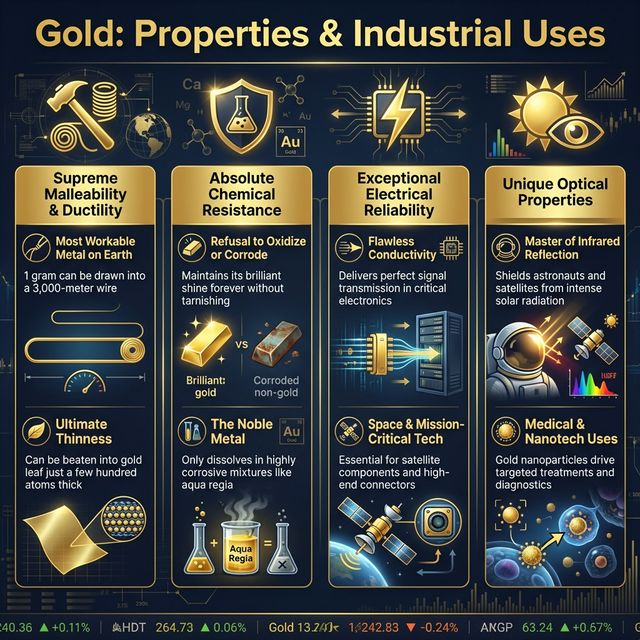
Gold (Au) is a transition metal with a face-centered cubic (FCC) crystal structure and possesses the highest malleability and ductility among all metals [1]. Its unit cell contains 14 atoms (8 at the corners, 6 at the face centers), with an atomic packing factor reaching 75% [1]. A single gram of pure gold can easily be beaten into a one-square-meter translucent sheet or drawn into extremely fine wire [1]. Its melting point is 1,064°C, its boiling point is 2,970°C, and it features a remarkably high density of 19.30 g/cm³; this high density is very close to that of tungsten (19.25 g/cm³), which has historically made it a prime metric for authentication and detecting forgeries [1].
The most notable chemical characteristic of gold is its outstanding resistance to corrosion and oxidation. As the least reactive of the noble metals, gold remains inert to most corrosive chemicals. It does not dissolve in single acids (such as nitric or hydrochloric acid); it only dissolves in aqua regia (a mixture of nitric and hydrochloric acid in a 1:3 volume ratio), in alkaline solutions of sodium cyanide, and in mercury (forming an amalgam) [1]. This property of dissolving exclusively in specific acid mixtures has long been utilized as the "acid test" to verify gold's purity [1].
Thanks to these metallurgical properties, gold is an indispensable material not just for jewelry, but also for critical industrial and electronic applications requiring high reliability. Because it possesses excellent electrical and thermal conductivity while refusing to form an oxide film on its surface, its contact resistance remains extremely low over long periods. As a result, it is widely utilized for plating microscopic switch contacts, connectors, and relays in printed circuit boards for mobile phones, computers, GPS devices, and satellites [1]. Annually, about 200 tons of gold are consumed by the electronics industry [1].
In the aerospace sector, gold serves as a solid lubricant for moving mechanical parts, replacing organic lubricants that would volatilize under extreme temperature changes or space radiation [1]. Furthermore, leveraging its unique optical property of strongly reflecting infrared light, gold is applied as a coating on polyester films to stabilize the temperature of spacecraft [1]. In a medical context, its high biocompatibility is utilized for dental alloys (based on the ISO 22674:2016 standard), for rheumatoid arthritis treatments (such as sodium aurothiomalate injections), and as radioactive isotopes for specific cancer therapies [1].
Since 24-karat pure gold is too soft on its own, it is alloyed with other metals depending on the application. Jewelry alloys (e.g., 18K, 75% gold content) include yellow gold (adding equal parts silver and copper, 12.5% each), rose gold (adding 20% copper to enhance the red hue), and white gold (adding 18.5% silver, 5.5% zinc, and 1% copper, followed by rhodium plating). A metallurgical approach is taken to control mechanical strength and color profile via the addition of specific elements [1].
6. Structural Issues Governing Supply and Demand
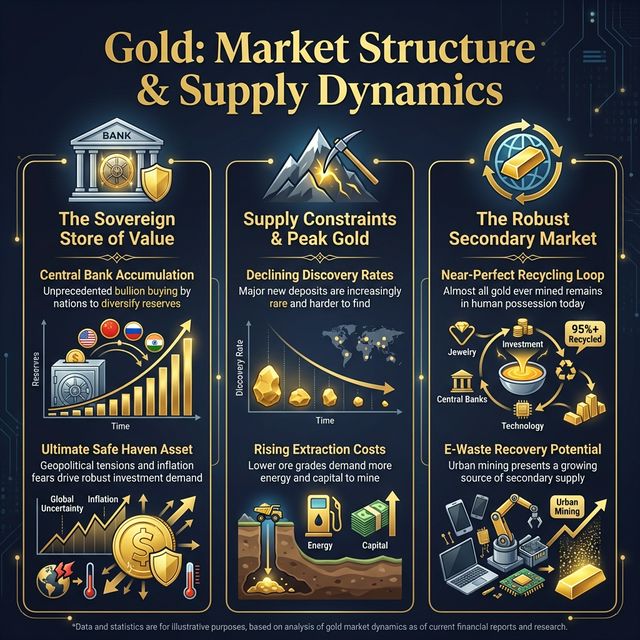
The supply and demand dynamics of gold operate on entirely different mechanics compared to other industrial metals. The most critical, unique circumstance is that gold is not merely an "industrial commodity" but intrinsically carries robust financial value as a hedge (safe-haven asset) against fiat currency credit risks [1]. Gold demand is heavily driven not just by industrial consumption or jewelry manufacturing trends, but by investor sentiment surrounding inflation fears, geopolitical risks, and economic uncertainty [2]. During economic downturns or geopolitical crises, while industrial demand may wane, investment demand as a store of wealth surges. This exhibits an "abnormal purchasing behavior" where the standard commodity rule of 'demand drops = prices fall' does not apply [1].
On the supply side, the most pressing structural challenge is the "declining ore grade" in mining and its consequent massive environmental toll [4]. While the world's primary gold deposits are mostly hydrothermal, years of extraction have depleted the most promising high-grade veins, making large-scale, low-grade open-pit mining the current mainstream [1]. Consequently, the volume of rock that must be mined and crushed to extract a single ounce of gold is growing exponentially, inflating the energy consumption (Scope 1 and 2 emissions) in both the extraction and beneficiation processes [4]. Gold mining is fundamentally an industry with extremely low resource efficiency, rejecting over 99% of extracted ore as waste rock (tailings) into the environment [7].
Environmental damage is particularly severe in Artisanal and Small-Scale Mining (ASM), notably in countries like Colombia. Extraction processes using the amalgamation method (mercury) or the cyanidation method cause toxic substances to leak into soil and water systems. A Life Cycle Assessment (LCA) study quantified that 55.2% of the total environmental damage score for small-scale mines was attributed to the cyanidation process, and 34.4% to the amalgamation phase, placing a massive burden on local ecosystems [8]. Furthermore, in areas like South Africa's Witwatersrand Basin, acid mine drainage (AMD) seeping from waste rocks serves as a long-term source of water pollution [7].
Secondary supply (recycling) also faces unique constraints. While recycling is well established in the jewelry sector, which accounts for roughly half of global gold demand, recovering gold from electronic devices (urban mining) runs into the barrier of economic feasibility [1]. Although roughly 1 billion mobile phones—each with an average lifespan of two years—are produced annually containing gold on their circuit boards, the gold content per phone is only worth about 50 cents [1]. Because the complexity and cost of the recovery process exceed this intrinsic value, enormous quantities of gold remain buried and scattered inside discarded electronics, preventing improvements in recycling rates and becoming a major industry bottleneck [1].
References
- [1] (PDF) Gold: Properties, Minerals, Alloys, Uses and Recycling
- [2] Determinants of the Physical Demand for Gold: Evidence from Panel Data \| Request PDF
- [4] DOI-10.5890-JEAM.2013.01.007 - L&H Scientific Publishing
- [7] Heavy Metal Pollution from Gold Mines: Environmental Effects and Bacterial Strategies for Resistance - PMC
- [8] Life Cycle Environmental Impact Assessment of Gold Production in an Artisanal Small-Scale Mine in Colombia - MDPI