Diamond Basic Statistics
Last updated: 2025-02-24
Compiled from USGS MCS 2026 and selected public supplements. Domestic U.S.-only notes are excluded where possible.
1. Highlights & Overview
- World production (2025) is approximately 38 million carats.
- Global reserves are approximately 1,700 million carats.
- The largest producer is Russia, accounting for about 42.1% of global output.
- In 2025, Russia ranked among the top producers (16).
- The top 3 countries account for about 73.7% of global output, indicating concentrated supply.
- Source: USGS MCS 原文PDF
2. Price Trends & Global Market (Events, Trends, and Issues)
- Most natural industrial diamond is produced as a byproduct of mining gem-quality diamond.
- Global natural industrial diamond production was essentially the same in 2025 as in 2024.
- Russia, the leading country in the production of natural industrial diamond, produced 16 million carats or 42% of total world production, followed by Congo (Kinshasa), 7 million carats (18%); Botswana, 5 million carats (14%); Zimbabwe, 5 million carats (13%); and South Africa, 3 million carats (8%).
- These five countries produced 95% of the world’s natural industrial diamond.
No quantitative usage breakdown (global basis) was found in the source text for this year.
3. World Mine Production and Reserves
Top Producing Countries(2025, Top 5)
Top Reserves (Top 5)
| Country | Production(2025) | Reserves |
|---|---|---|
| Russia | 16 | 750 |
| Congo (Kinshasa) | 7 | 150 |
| Botswana | 5 | 250 |
| Zimbabwe | 5 | 56 |
| South Africa | 3 | 87 |
| Angola | 1 | 150 |
Unit: 百万カラット
4. Supply-Demand Balance Trend
No time-series supply-demand balance data found in public sources for this mineral.
5. Metallurgical & Physical Properties and Industrial Uses
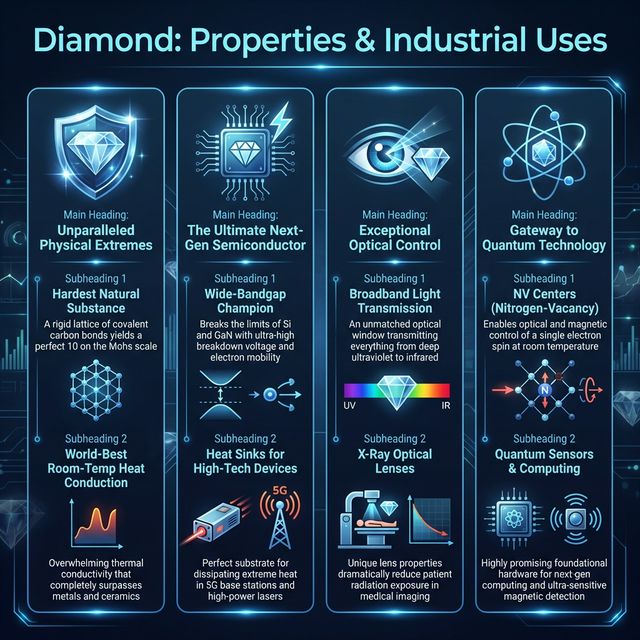
Diamond (C) is an allotrope of carbon in which the atoms form a strong, three-dimensional tetrahedral structure (diamond lattice) via covalent bonds. While it is best known for its brilliance as a gemstone, from a scientific and industrial standpoint, diamond is the "ultimate engineering material" encompassing a suite of extreme physical properties [59].
Its foremost physical characteristic is possessing the highest hardness of any natural substance on Earth (Mohs hardness of 10). Alongside this, it boasts the "highest thermal conductivity at room temperature in the world," surpassing metals and ceramics [59]. Furthermore, as an electronic material, diamond is a wide-bandgap semiconductor with a very broad bandgap of 5.5 eV, exhibiting a high breakdown electric field and extremely high electron and hole mobility [60]. In terms of optical properties, it has high transmittance across an incredibly broad range of wavelengths—from deep ultraviolet (DUV) through visible light to infrared—and is almost completely chemically and biochemically inert (exhibiting excellent chemical resistance) [59]. Additionally, by artificially manipulating specific lattice defects, it demonstrates unique lens properties capable of reflecting and focusing X-rays [3].
Traditional industrial applications had been limited primarily to low-quality stones from natural mines unsuitable for jewelry (bort), or powders synthesized via detonation or cavitation methods, which were used as abrasives, cutting tools, and drill bits [3].
However, owing to the evolution of vapor-phase synthesis technologies—which will be discussed later—the production of high-purity, large-area single-crystal and polycrystalline diamonds has become possible, spurring an explosive expansion of its applications as a core material for next-generation high-tech industries [59]. Specifically, it is utilized as the "ultimate heat dissipation substrate (heat sink)" to manage the extreme heat generated in 5G communication base stations, high-power lasers, and RF devices for aerospace radar [60]. It is heavily anticipated as a device material that can shatter the thermal limits of conventional semiconductors like silicon (Si) and gallium nitride (GaN) [60]. It is also being applied to deep ultraviolet (DUV) LEDs, high-power photodetectors, particle/radiation detectors, optical windows for artificial satellites, and MEMS sensors operating in harsh environments [59].
The most revolutionary application in recent years is in the field of "quantum technology." A lattice defect known as an "NV center (nitrogen-vacancy center)," formed by replacing a carbon atom in the diamond crystal lattice with nitrogen and pairing it with an adjacent vacancy, possesses the astonishing ability to allow the optical and magnetic control of single electron spins at room temperature [62]. Leveraging this, research and development are advancing globally to use diamond as a cornerstone hardware material for quantum computers, as well as for ultra-sensitive quantum sensors capable of detecting brain magnetic fields and minute magnetic fluctuations at room temperature [59]. Furthermore, in the medical field, its use as an X-ray optical lens is being commercialized as a groundbreaking technology to significantly reduce patients' radiation exposure [3].
6. Structural Issues Governing Supply and Demand
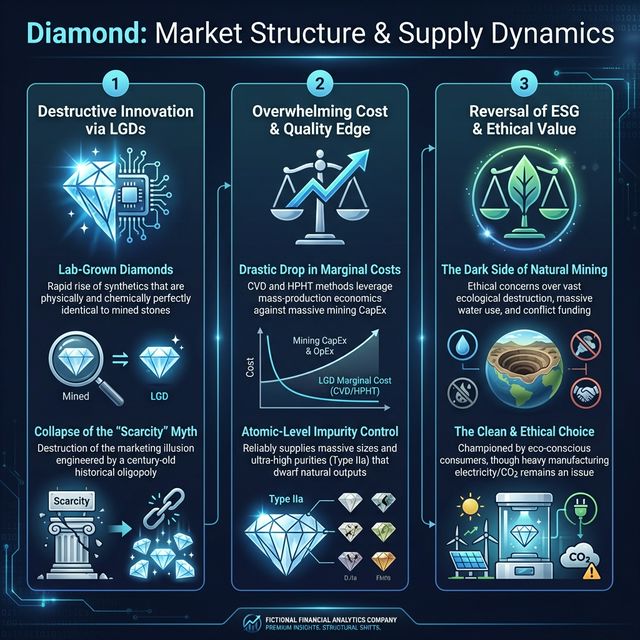
The diamond market is currently caught in the vortex of a highly dramatic special circumstance: a massive paradigm shift that is fundamentally upending hundreds of years of industrial history—the destruction of the traditional market structure by the rise of "lab-grown diamonds (LGDs)."
Historically, the natural diamond market's supply volumes and prices were strictly controlled for a long time by a rigid oligopolistic cartel led by a few giant mining companies, epitomized by De Beers [63]. The pricing of natural diamonds is heavily sustained not by physical utility like metals, but by intangible value (the Veblen effect) artificially created through marketing centering around "scarcity" and "proof of love (engagement rings)" [3]. From a behavioral economics perspective, it has been a peculiar market exhibiting "purchasing anomalies," where consumers pay a steep premium for expensive "naturally sourced" stones even when cheaper and superior alternatives exist [3]. In academic papers, this is likened to Kazimir Malevich's painting "Black Square" (a painting anyone could draw, but only the original holds astronomical value) [3].
However, technological evolution has breached this fortress of monopoly. Lab-grown diamonds (LGDs) produced via Chemical Vapor Deposition (CVD) or High-Pressure High-Temperature (HPHT) methods possess structures that are physically, optically, and chemically "completely identical" to natural diamonds [64]. On the contrary, because natural stones are serendipitous products of the Earth's tectonic activity, impurities are randomly mixed in. LGDs, however, are grown under strict technical control inside vacuum chambers in cleanrooms, allowing for the atomic-level control of impurity doping (like nitrogen or boron), enabling the stable and cheap production of stones with sizes and high purities (e.g., Type IIa) that dwarf natural stones [3].
This low production cost is disruptive. Mine development (such as the Gahcho Kué mine) requires massive capital expenditure (CapEx) of 217 USD per carat of annual production, and the cost of mining from deep underground is rising year by year [3]. In contrast, while the initial investment for LGDs is high—500 to 833 USD for HPHT and 549 to 1648 USD for CVD—once the equipment is installed, marginal costs are low. Furthermore, it holds the potential to dramatically boost productivity through advancements in physics (optimizing microwave power and gas ratios) [3]. Consequently, LGDs are supplied to the jewelry market at prices 20% to 30% cheaper than natural stones, rapidly capturing the middle-class and millennial demographic—who are highly price-sensitive—and causing natural diamond prices to plummet to multi-year lows [3].
Moreover, ESG (Environmental, Social, and Governance) perspectives have also become a decisive factor bifurcating the market [64]. Mining natural diamonds involves immense ecological destruction through open-pit mining, the excavation of massive volumes of soil, and the consumption of large amounts of water—5 to 6 times more than that used for synthetic diamonds [3]. Additionally, it bears ethical dark sides, including labor environment issues and a grim past history as a source of funding for conflicts (blood diamonds) [3]. By contrast, LGDs tout themselves as "conflict-free" and "ethical," strongly appealing to eco-conscious consumers [65].
However, LGDs also have an Achilles' heel. Maintaining high-temperature plasma states or ultra-high pressures for extended periods to grow the diamonds requires enormous electrical energy. Critics point out that if this electricity is not sourced from renewable energy, it results in the substantial emission of greenhouse gases (CO2), meaning it cannot be considered truly "sustainable" [3]. Going forward, securing the carbon footprint and transparency across the entire supply chain will be the key determining the survival or elimination of lab-grown enterprises. Furthermore, economic sanctions by Western nations against Russia have restricted the circulation of rough stones from Russia—the world's leading producer of natural diamonds—which is further fueling supply chain restructuring and price volatility [64].
While the mining volume of natural diamonds has been in a declining trend after peaking at around 177 million carats in 2005 (down to 116 million carats in 2021), LGD production continues to grow rapidly at an astonishing pace of over 7% annually [3]. The diamond market currently finds itself right in the midst of two profound historical turning points: the collapse of the myth of scarcity, and the dawn of a new technology industry heralding the ultimate semiconductor material.
References
- [1] (PDF) Gold: Properties, Minerals, Alloys, Uses and Recycling
- [3] Comparative analysis: CapEx in diamond mining versus diamond \...
- [9] Silver - Mineral Commodity Summaries 2024 - USGS.gov
- [13] (PDF) The Evolving Copper‐Tellurium Byproduct System: A Review of Changing Production Techniques & Their Implications - ResearchGate
- [18] Platinum-group elements: So many excellent properties - USGS Publications Warehouse
- [25] A Review of Recovery of Palladium from the Spent Automobile Catalysts - MDPI
- [33] Lithium - USGS Publications Warehouse - USGS.gov
- [49] The Impact of Uranium Resource Constraints on China\'s Nuclear Power Development
- [59] Applications of diamond films: a review - Taylor & Francis
- [60] A perspective on diamond heterojunction devices \| Applied Physics Letters - AIP Publishing
- [62] Recent progress in hybrid diamond photonics for quantum information processing and sensing - PMC
- [63] (PDF) Study on the Impact and Reshaping of the Rise of Lab-Grown Diamonds on the Monopolistic Structure of the Traditional Diamond Market - ResearchGate
- [64] The diamond industry is at an inflection point - McKinsey
- [65] Lab-Grown Diamonds: Reshaping the Gemstone Market - IOSR Journal